Stubaital: The Family Chalet and the Value Case
Neustift, the Stubaier Gletscher, and the lowest glacier entry in Tyrol.
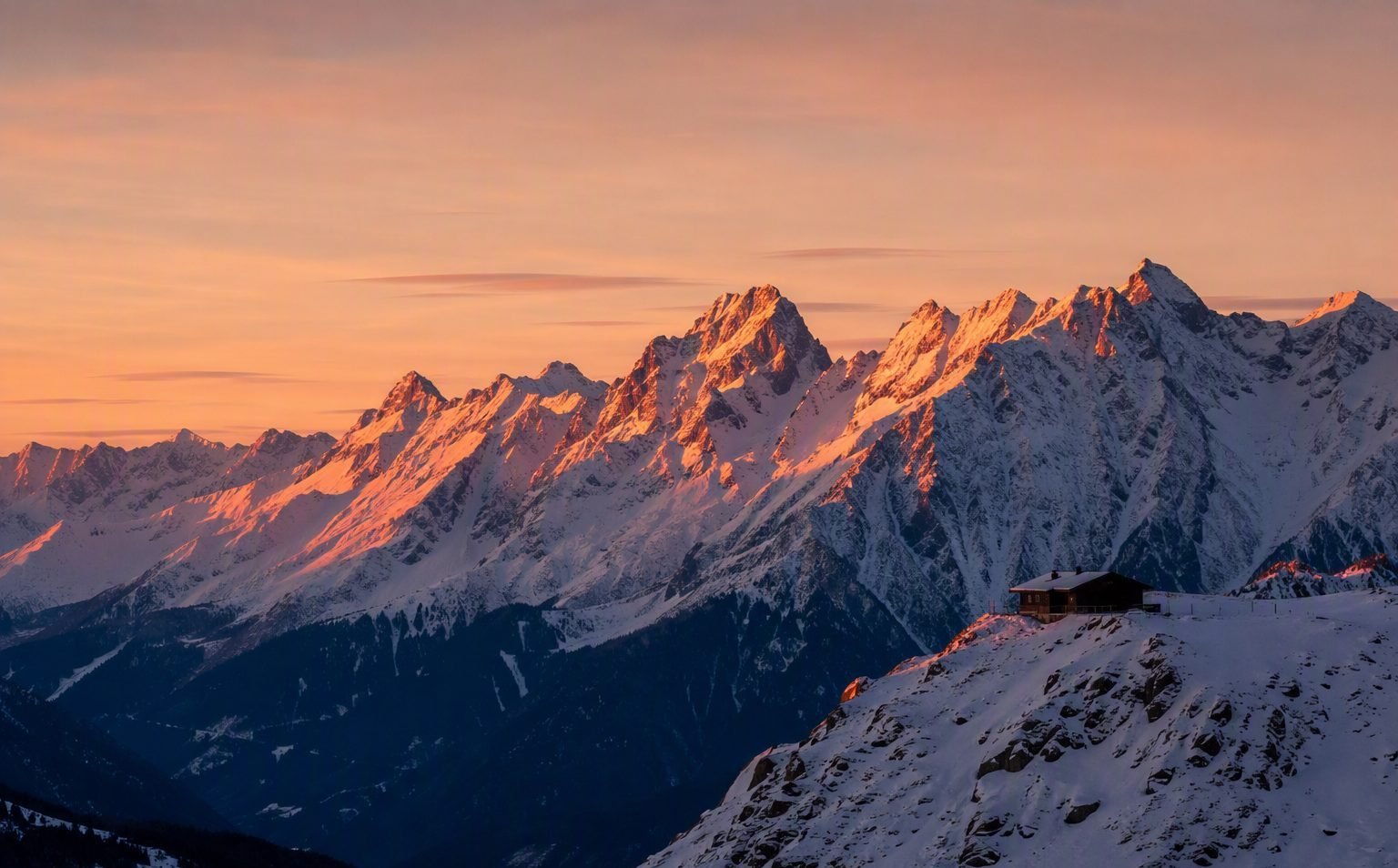
Alpenglow over the Stubai ridge, 25 minutes from Innsbruck.
Innsbruck Office — Current Conditions
Updating...
Thirty-Five Kilometers, Twenty-Five Minutes
The Stubaital makes its argument with two numbers, so let's put them on the table immediately: the valley runs 35 kilometers south from the edge of Innsbruck to the foot of the Stubaier Gletscher, and the airport-to-village drive is about 25 minutes. Not 25 minutes in resort-brochure time, which is measured downhill with a tailwind. Twenty-five minutes in a rental car on a Tuesday in February, with luggage and a child asleep in the back. In Alpine real estate, access is destiny, and no glacier valley in Austria has access like this one.
The glacier itself tops out around 2,900 meters of skiable terrain — the lift system's upper stations reach above 3,200 — and it operates from autumn into early summer with the kind of reliability that lets a family book an October week without holding its breath. The valley floor villages, though, sit at modest elevations: Neustift at roughly 1,000 meters, Fulpmes a touch lower, Telfes and Mieders on the sunny terraces, Schönberg guarding the entrance near the motorway. This is the Stubaital's defining contrast: a genuine high-alpine glacier at the top of the road, and below it, lived-in farming villages with reasonable prices, working schools, and guesthouses that have taken the same families for thirty years.
And that's the character of the market in one sentence: family-oriented, mid-priced, and unbothered by fashion. There's no Gucci store in the Stubaital. There's no champagne bar with a DJ. The valley doesn't compete with Kitzbühel's glamour or even Sölden's scale, and — this is the part that should interest an investor — it doesn't price like them either. What it offers instead is a deep, loyal, repeat-visit family market: German, Dutch, and increasingly Austrian families who come because the skiing is honest, the ski schools are excellent, the glacier guarantees the snow, and the whole week costs half of what the same week costs forty minutes east. Repeat visitation in this valley runs at levels luxury resorts would kill for. Families return to the same apartment house in Neustift for a decade, then book their children's families into the apartment next door.
For the American buyer, the practical implication is a market that behaves more like a solid suburban rental than a trophy asset. Demand is broad rather than deep-pocketed, occupancy is driven by school-holiday calendars rather than society calendars, and the tenant — forgive the word — is a family of four from Bavaria who books the same fortnight every February and takes care of the place because they intend to come back. There are worse foundations for an investment.
The Chalet Segment: Sized for Reality
The Stubaital chalet is a different creature from the Ötztal lodge. Think 100 to 200 square meters, three to four bedrooms, a proper kitchen because families cook, a mudroom that can handle eight pairs of boots, and — increasingly non-negotiable in the rental market — a sauna, even a small one. These houses sleep six to ten, and they're let by the week to guests who arrive by car with a roof box and a grocery list. The construction is typically wood or wood-over-masonry, pitched roofs, deep eaves; the Tyrolean building code insists on it in most of the valley, and frankly the valley looks better for the insistence.
Pricing is where the value case begins. Across the chalet segment, expect €4,200 to €6,800 per square meter depending on village, position, and condition. The benchmarks we use internally: Neustift village center — walkable to the ski bus, the bakery, and the Elfer lifts — runs about €5,800 per square meter for good stock. Hillside positions above Neustift or in Fulpmes, with the panoramic view but a five-minute drive to anything, run about €4,500. At the top of the range you're buying new or near-new construction in prime Neustift; at the bottom, an older house in a mid-valley village that needs a heating system and a frank conversation. Compare those numbers with €5,500 to €8,500 in Sölden or five figures in Kitzbühel's better streets, and you'll understand why we call the Stubaital the value glacier market. It's the lowest per-square-meter entry into a major Tyrolean glacier region, full stop.
The 25-minute airport drive deserves its own paragraph, because it creates a demand segment the other glacier valleys simply don't have: the weekend market. A Munich family can leave the office at four on a Friday and be in their chalet by half past six, skis already in the garage. Vienna is four hours, an easy Friday drive. That turns the Stubaital chalet into a genuine 52-week asset for its owners — long weekends in May, autumn color weeks, Christmas markets in Innsbruck with a daytime ski on the glacier — in a way that a property ninety minutes beyond the airport never quite is. When we model owner usage, Stubaital owners average nearly double the personal-use nights of Kitzbühel owners. That's not a lifestyle statistic. It's the difference between an asset your family loves and an asset your family visits.
| Stubaital Market Snapshot | Figure | Note |
|---|---|---|
| Valley length | 35 km | Innsbruck to the glacier |
| Stubaier Gletscher ski elevation | to ~2,900 m+ | Upper lifts above 3,200 m |
| Innsbruck airport drive | ~25 minutes | vs. ~90 minutes to Kitzbühel |
| Chalet size band | 100–200 m² | 3–4 bedrooms, family layout |
| Chalet pricing | €4,200–€6,800 / m² | Lowest glacier entry in Tyrol |
| Neustift village center | ~€5,800 / m² | Walkable, prime stock |
| Hillside / mid-valley | ~€4,500 / m² | Views, older stock, value band |
| Gross rental yield | 4.5%–6.2% | Family weekly lets |
| Net rental yield | 3.2%–4.5% | Highest net in the glacier regions |
The Villages, One by One
Neustift is the anchor and, for most buyers, the whole conversation: the largest village, the Elfer and Serles lifts on its doorstep, the glacier road running through it, the grocery stores, ski schools, and sports shops that make a rental property self-sufficient. Village-center stock walks to everything, and that walkability shows up in your booking rate — families with small children pay for it without quite knowing they are. Fulpmes, a few kilometers down-valley, is the working village: the Stubai Valley Railway terminus, the Schlick 2000 gondola, a proper trades economy, and pricing a step below Neustift for what is often a larger house. Buyers who prioritize square meters over address should spend an afternoon there before they commit.
Telfes and Mieders sit on the sunny terraces mid-valley — quieter, cheaper, view-rich, and dependent on the car and the ski bus. They suit the owner-user who wants calm and accepts a thinner rental calendar in exchange. Schönberg, at the valley mouth, is barely a resort at all, and that's its pitch: ten minutes from the city, priced almost like an Innsbruck suburb, and defensible on pure owner-utility grounds even if the rental case is modest. We mention it because clients who fail the Zweitwohnsitz screen up-valley sometimes land here happily. And at the top of the road, the hamlets near the glacier — Ranalt, Milders, the scattered farmsteads toward the lift base — trade rarely and quietly, in stock that's old, cold, and priced on land value. Tempting on the map, difficult in practice; the drive in January is a commitment, and your guests will feel that in their reviews.
The pattern across all five is the same, and it's the pattern that makes this valley easy to advise on: the closer to Neustift's center and the glacier road, the stronger the rental book; the further out, the more the purchase is a lifestyle decision with rental income as a subsidy rather than a return. Neither is wrong. But know which one you're signing for, because the valley sells both on the same street and sometimes at the same price.
Rental Yield: Family Blocks and Self-Check-In
Here's the number that surprises people who come to us fresh from the Kitzbühel pages: Stubaital chalets produce the best net rental yields in Tyrol's glacier regions. Gross yields run 4.5 to 6.2 percent; net, 3.2 to 4.5 percent. Both bands sit a full point or more above the Ötztal lodge segment, and the reason isn't that the Stubaital earns more per square meter — it doesn't. The reason is that it costs less to earn.
Start with the booking pattern. Family rentals in this valley come in one- and two-week blocks, anchored to the school-holiday grid: the February ski weeks, Easter, the long summer holidays from mid-July through August, the autumn break, Christmas. A well-positioned Neustift chalet can carry 28 to 34 booked weeks a year with only eight to twelve changeovers, and changeovers are where rental margin goes to die. Every Saturday handover is a clean, a linen cycle, a hot-tub drain-and-refill, a checklist. Twelve changeovers instead of thirty is the difference between a manageable operation and a part-time job you didn't apply for.
Then consider the management intensity — or rather, the lack of it. The luxury segment runs on concierge: pre-stocked fridges, restaurant bookings, a driver for the glacier road, a host who answers messages at eleven at night. That service layer costs 22 to 28 percent of gross and, more importantly, it requires a caliber of local staff that's scarce and getting scarcer. The Stubaital family market doesn't expect concierge and won't pay for it. Self-check-in via key box or smart lock is common and accepted; a WhatsApp number for the caretaker is considered attentive service; the guests bring their own groceries and often their own bed linen preference. A competent local Hausmeister service plus a cleaning crew covers the operation for 12 to 16 percent of gross, all-in. The gap between 24 percent and 14 percent management cost is, roughly speaking, the entire yield advantage of this valley. It isn't glamorous. It's arithmetic.
The weekly rates, for calibration: a 150-square-meter Neustift chalet sleeping eight lets for €1,800 to €2,600 per week in the core winter season, €2,800-plus over Christmas and the February peak, and €1,200 to €1,600 in summer, when the glacier still skis in the morning and the valley swims and hikes in the afternoon. Shoulder weeks in November and late April are soft — the glacier keeps turning, but family demand follows school calendars, not snow reports. Underwrite 26 weeks at conservative rates and let the autumn weeks surprise you; the October glacier season, when Munich families arrive for the first snow while the lakes further north are still warm, has been quietly growing for a decade.
The Value Proposition, Stated Plainly
Let's assemble the case without decoration. First: the Stubaital offers the lowest entry price per square meter in any major Tyrolean glacier region — roughly 30 to 40 percent below Sölden and less than half of Kitzbühel's prime stock, for access to a glacier every bit as reliable. Second: the access advantage is structural, not incidental. Twenty-five minutes from Innsbruck's airport and mainline station, versus roughly ninety minutes to Kitzbühel from the same airport and more to Sölden. In a warming climate, altitude decides whether your resort has snow; in any climate, drive time decides how often your guests and your family actually use it.
Third: the demand catchment. Within a four-hour drive of Neustift sit Munich, Stuttgart, Nuremberg, Augsburg, and the whole Bavarian and Swabian belt — call it 3.5 million Germans in the immediate two-hour ring and multiples of that at four hours, in Europe's highest-propensity-to-ski market. These are drive-to guests, which makes the demand base recession-resistant in a specific way: when budgets tighten, the German family doesn't stop skiing; it trades the flight to Colorado for the drive to the Stubai. The valley's booking books showed exactly that pattern in 2009 and again in 2020's aftermath — occupancy dipped less, and recovered faster, than in the flight-dependent luxury resorts. We're not promising recession-proof. We're pointing at a demand base with a shorter supply chain.
Fourth — and we say this as people who also sell the idea of the glamorous valleys — the Stubaital is where the price-to-utility ratio peaks. A euro here buys a house your family will use forty nights a year, that rents to undemanding guests in long blocks, that costs less to hold, and that sits in a genuine year-round recreation economy forty minutes from a university city's jobs and hospitals. The glamour premium you don't pay is also a glamour premium you don't need to defend on exit.
Construction, Renovation, and the Style Police
Many of the best Stubaital buys are older houses — 1960s to 1980s stock, solid bones, tired systems — so let's price the work. A full renovation in the valley currently runs €2,800 to €3,500 per square meter: new heating (and do take the heat-pump quote seriously, because Tyrol's subsidy programs are generous and the guests increasingly ask), new electrics, windows, insulation to current code, kitchen and baths, and the sauna your listing photos will need. New-build costs €4,200 to €5,500 per square meter for good alpine-standard construction, land excluded, and the spread inside that band is mostly fit-out: larch versus spruce, tile versus oak, and how serious the kitchen is.
Now the constraint that shapes every project in the valley, and that American buyers consistently underestimate: in the protected zones — and much of the Stubaital's village fabric qualifies — the Alpine style is effectively mandatory. Wood or stone facade treatments, pitched roofs within prescribed angles, eaves proportions, balcony detailing, even the palette of permitted render colors. The Baubehörde is not being precious; the valley's visual coherence is precisely what keeps the booking calendars full, and the code protects your investment by protecting the view from your neighbor's hypothetical flat-roofed experiment. But it means your renovation budget must include an architect who works in the idiom daily, and it means the modernist glass box you saw on a design blog is not happening in Neustift. Budget €40,000 to €60,000 for architecture, engineering, and permits on a full renovation, and add four to six months to whatever timeline the first quote promised you. Everyone's first renovation teaches this. We'd rather yours taught it cheaply, on paper.
One practical note on trades: the valley's proximity to Innsbruck is as much a construction advantage as a tourism one. You're inside the daily commuting radius of a city's full bench of contractors, suppliers, and specialists, which keeps renovation pricing meaningfully below the remote resort valleys and — more valuable — keeps schedules honest. The carpenter who can drive home at night shows up again on Monday. Buyers who've renovated in more remote valleys will understand exactly what that's worth.
Case Study: 150m² in Neustift
From our files, with the usual identifying details blurred. A 150-square-meter chalet, 1990s construction, renovated in stages over the last decade, four bedrooms, sauna, ten minutes on foot from the Elfer lift base and the village center. Purchase price €810,000 — €5,400 per square meter, right on the Neustift benchmark. Transaction costs at the standard Austrian stack — 3.5 percent transfer tax, 1.1 percent registry, about 1.5 percent notary and contract, no buyer's agent on this one because the client found it through a local contact — came to roughly €50,000. All-in basis: €860,000.
The operating year: 24 booked weeks at a blended €1,750 — heavy winter weighting at €2,400 to €2,900 for the February and Christmas weeks, summer fortnights at €1,400, a scattering of spring and autumn weekends. Gross rental income: €42,000, which is 5.2 percent of the purchase price. Costs: local Hausmeister-plus-cleaning arrangement at about 14 percent of gross, utilities, linen, platform fees, insurance, reserves. Net to owner: €29,000. Net yield on purchase price: 3.6 percent — the highest net yield we've verified in any of Tyrol's glacier regions this cycle, produced by the least glamorous property class we cover.
The owner uses the chalet five weeks a year, drives the booking calendar around school holidays, and has changed nothing about the operation in three years except the hot-tub cover. That's the Stubaital investment experience at its best: uneventful, in the way income property is supposed to be uneventful. The appreciation case is steadier than spectacular — 3 to 4 percent annually on a long view, with the valley's access advantage and the glacier's climate resilience doing the heavy lifting — and the exit market is broad, because the buyer pool includes not just investors but every Innsbruck professional family who ever wanted a place up the valley. Liquidity is genuinely better here than in the trophy resorts. Lower price points mean more qualified buyers. That sentence is obvious, and yet it gets forgotten every time someone falls in love with a view.
The Honest Caveats
Buyer-protective means telling you what can go wrong, so: four things. First, village elevations are low. Neustift at 1,000 meters does not get reliable valley snow, and in a warm winter your guests ski the glacier and the Schlick 2000 lifts above Fulpmes, not the nursery slope behind the house. The rental market understands this — it's priced in — but your listing must be honest about it, and your underwriting should assume the glacier does all the winter work. Second, Zweitwohnsitz rules apply here as everywhere in Tyrol: properties without touristic dedication can't simply be kept as a second home by a non-resident, and the valley's enforcement has tightened. Verify the title's dedication status before you negotiate price, not after. Third, the summer season, while real, is weaker than the Ötztal's; the Stubai sells hiking and family holidays, not a brand. Model June and September conservatively. Fourth, the same accessibility that fills the valley on weekends can clog it — the glacier road queues on peak February Saturdays, and your guests will mention it in reviews if you haven't warned them. Warn them.
None of this overturns the case. The Stubaital remains what it has quietly been for decades: the sensible buy. The lowest glacier entry in Tyrol, the shortest airport drive in the Alps' top tier, the gentlest operations, and the best net yield in our coverage. Not every portfolio needs a trophy. Most need a house like this one.
Next steps, in order: the full fee stack is on our acquisition cost breakdown, and the booking-block patterns described above are modeled week by week on the rental occupancy page.
Tyrol Crest Estates is not a real estate brokerage. This content is for informational purposes only and does not constitute investment advice.