Kitzbühel Alps: The Luxury Resort Chalet Market
Hahnenkamm pedigree, ski-in/ski-out premiums, and the honest math of owning a trophy asset that rents twelve weeks a year.
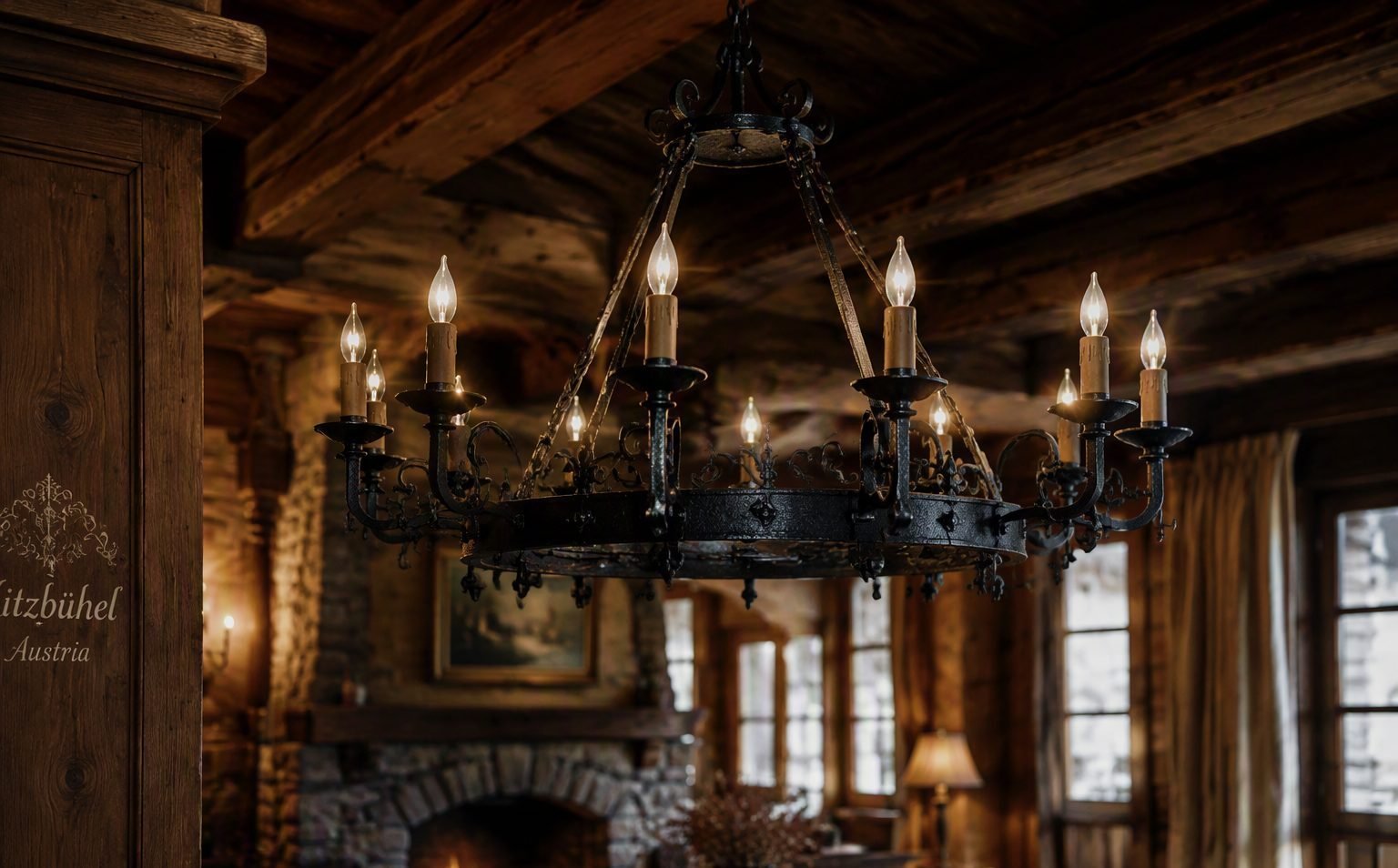
Hand-forged iron over a Jochberg great room.
Innsbruck Office — Current Conditions
Updating...
Kitzbühel Market Overview
Kitzbühel is the most prestigious ski resort in Austria, and it has held that title since before prestige was a marketing word. The Hahnenkamm downhill — the Streif, run every January since 1931 — is the most feared race on the World Cup circuit, and for one week a year the town becomes the center of the skiing world. The rest of the winter it settles back into being what it actually is: a medieval walled town of about 8,200 permanent residents that swells past 25,000 when the visitors arrive, serving a ski area of roughly 120 kilometers of groomed slopes, linked by lift to Kirchberg, Jochberg, and the Mittersill side of the Kitzbüheler Alps.
Understand the population ratio first, because it explains everything about the property market. Eight thousand two hundred residents; twenty-five thousand winter beds occupied at peak. Three out of four pillows in town belong to someone who doesn't live here. That ratio is why Kitzbühel real estate prices behave like a luxury goods market rather than a housing market — driven by international wealth, brand cachet, and scarcity, with almost no relationship to local incomes. The local schoolteacher doesn't buy the chalet next door. The Munich industrialist does, or the London fund manager, or increasingly the American family office.
Access is better than the map suggests. The town sits 75 kilometers from Salzburg Airport and about 100 from Innsbruck, both roughly an hour on cleared roads, and Munich's intercontinental hub is 90 minutes the other way. Private aviation uses Salzburg and Innsbruck interchangeably. A rail line runs directly into town with sleeper service from Vienna. Among the serious Alpine resorts, only St. Moritz matches this combination of brand and reachability, and St. Moritz prices sit in another tax bracket entirely.
A word on the season, because buyers consistently misjudge it. Kitzbühel is not a one-sport town that dies with the thaw. The KitzSki area opens in October some years and runs into April, but the summer calendar is its own machine: four golf courses inside the town boundary and a dozen more in the valley, the ATP tennis tournament in August, hiking and road-cycling traffic from June to September, and a classical-music program that fills the hotels in the shoulder weeks. Summer doesn't drive chalet rents the way winter does — the weekly rates run 40-60% below peak — but it matters for two reasons. It keeps the service economy (and therefore your concierge, your cleaner, your plumber) solvent and present year-round, and it gives the owner family a second season of personal use that doesn't cost €6,000 of foregone rent every time they visit.
The market's defining feature is supply, or rather the absence of it. Tyrolean zoning law is hostile to new luxury construction in the Kitzbüheler Alps — new-build chalets above a certain size face permit battles measured in years, and much of the surrounding hillside is protected pasture. What exists is what sells. In a normal year, perhaps three to five dozen chalets in the €1-3 million band change hands across the whole Kitzbühel-Kirchberg-Jochberg axis. Thin markets cut both ways: they protect value in downturns, and they test your patience when you buy and when you sell.
The Chalet Segment: What the Money Buys
The investable chalet here runs 120 to 300 square meters of living space — anything smaller is an apartment wearing a chalet's clothes, and anything larger is an estate with its own staffing problem. Within that band, location splits the market into two clear tiers.
In the village center and the favored slopes immediately around the Hahnenkamm and Fleckalm lifts, prices run €9,500 to €16,000 per square meter. The top of that range buys a renovated property with a Streif view and a walk to the lift measured in minutes. The bottom buys an honest chalet on a good street that needs work. In the surrounding hills — the slopes above Jochberg, the Aurach side, the quieter edges of Kirchberg — the same money stretches much further: €6,500 to €9,000 per square meter, with more land, more privacy, and more driving in February.
The Ski-In/Ski-Out Premium
The single largest price variable in this market is the door-to-slope question. A true ski-in/ski-out chalet — click in at the terrace, ski to the lift, ski home at day's end — commands a 35% to 50% premium over a comparable walk-to-lift property. We've tracked this spread across enough transactions to trust it, and it has widened since 2019 as the buyer pool has skewed older and richer. Convenience is the luxury good here; square meters are the commodity. Note the consequence for investors: the premium you pay at purchase is the premium your tenants pay at rental. Ski-in/ski-out chalets achieve the highest weekly rates and the fastest bookings, and they hold both through soft winters. But they start at a price basis that caps your yield. There is no configuration of this market where you get the trophy location and the urban yield. Choose which one you're buying.
Price Map of the Kitzbüheler Alps
| Location | Price (€/m²) | Ski-in/Ski-out Premium | Peak Weekly Rent (180m²) | Profile |
|---|---|---|---|---|
| Kitzbühel village center | €9,500-16,000 | +35-50% | €5,500-8,000 | Trophy, lowest yield |
| Hahnenkamm / Fleckalm slopes | €11,000-16,000 | Included in price | €6,000-9,000 | Ski-in/ski-out core |
| Jochberg | €7,500-9,500 | +35-40% | €4,000-5,500 | Best value for quality |
| Kirchberg | €6,500-8,500 | +30-40% | €3,500-5,000 | Livelier, younger crowd |
| Surrounding hills / Aurach | €6,500-9,000 | Rarely available | €3,000-4,500 | Privacy play, drive to lifts |
Read the table and notice what's missing: there's no row under €6,500. Unlike Innsbruck, Kitzbühel has no working-class yield district to fall back on. The whole market is priced as a resort, top to bottom. That's the trade you make for the brand.
Rental Yield: The Honest Arithmetic
Let's say the quiet part first, because a buyer-protective advisor says it on page one: chalet yields in Kitzbühel are thin. Gross yields on a seasonally rented luxury chalet run 2.8% to 4.5%. Net yields — after management, VAT, cleaning, maintenance, heating, and every other line in the ledger — run 1.8% to 3.2%. If you need 5% net, stop reading this page and go back to the Innsbruck studios; we mean that kindly and we mean it seriously. The Kitzbühel chalet is a wealth-preservation and lifestyle asset that happens to produce income, not an income asset that happens to be a chalet.
Within those ranges, the spread is driven by three variables: location (see the premium discussion above), winter length (a late-December-to-March rental program out-earns a Christmas-only one by 40%), and how aggressively the owner blocks personal weeks. Every peak week you keep for yourself costs €4,000-8,000 of foregone rent. We never lecture clients about it — skiing your own chalet is half the point — but we do make them write the number down.
The Regulatory Stack: VAT, Registration, and the 90-Day Cap
Short-term rental in Austria is a regulated business, and the regulation is where foreign owners' spreadsheets go wrong. Three items matter most.
First, VAT. Short-term accommodation in Austria carries 24% value-added tax on the rental price once you pass the small-business threshold — and a chalet renting at €4,000 a week passes it in February. Depending on structure, some of this is recoverable or pass-through, but in the standard private-owner case, VAT is a real cost that compresses gross-to-net by a margin most US investors have never seen on a rental property. This is one reason the GmbH ownership structure, covered below, is so common at the top of the market.
Second, registration. Tourist letting in Tyrol requires registration with the local Tourismusverband — the tourist board — and payment of the overnight stay tax, the Nächtigungsabgabe, collected per guest per night and remitted to the municipality. It's not optional, it's not obscure, and the tourist boards in the Kitzbüheler Alps are well staffed and entirely unembarrassed about auditing. Budget the compliance cost and the accountant's time, and don't let a rental agent tell you it's handled without showing you the registration number.
Third — and newest — rental caps. Several Tyrolean municipalities have introduced or proposed annual rental-day limits for non-primary residences, commonly around 90 days per year, as political pressure over housing for local workers has mounted. Kitzbühel's rules as of this writing are more permissive than the strictest valley towns, but the direction of travel across Tyrol is one-way: tighter. Underwrite your chalet to 90 legal rental days and treat anything above as upside. A rental program that fits inside the cap — twelve peak winter weeks is 84 days — is robust to any plausible regulation. A program that needs 150 days to pencil is a bet on the political weather, and we'd rather bet on the actual weather.
Operational Costs: What a Chalet Eats in a Year
The cost side of a luxury chalet surprises even experienced US landlords, because the cost categories are different, not just bigger. Altitude and tradition both tax the building. Here is the realistic annual stack for a 180m² chalet in the Jochberg band, in the numbers we'd use in our own underwriting.
Ski-area and winter-specific maintenance runs €4-6 per square meter per year — roof snow management, ice-dam inspection, exterior woodwork treatment against freeze-thaw, and the heating system's winter workout. Call it €900 for the example chalet. Heating itself, on a modern biomass (wood-pellet) system, runs €2-3 per square meter per year — €450 or so — and is genuinely cheaper than oil or gas at this altitude, which is why nearly every renovated chalet in the valley has converted. Altitude lifts both lines above what the same building would cost in Innsbruck: colder winters, harsher UV, heavier snow loads on every beam.
Then come the lines that don't exist on a city apartment. Concierge and property service for a luxury chalet — keyholding, guest check-in, hot tub chemistry, snow clearing at 6 a.m., the florist before the Christmas tenants arrive — runs €8,000 to €12,000 per year from one of the local service firms, and at the €4,000-a-week rental level it is not optional. Guests paying that rate expect a house that performs like a hotel. Cleaning and linen turn between rental weeks: €350-500 per turn, and a twelve-week season means a dozen turns. Utilities, insurance (higher than urban, reflecting snow-load and guest liability), garden and drive maintenance, the repair reserve: another €4,000-6,000 combined in a typical year.
And management itself: 18-25% of gross rental revenue for a full-service seasonal program in Kitzbühel, against 8-10% in Innsbruck. The percentage is higher because the work is higher-touch and the revenue is concentrated in a dozen weeks. When a rental agent quotes you 15%, he's quoting his commission and leaving the linen, the concierge, and the tax filings for someone else's invoice. Read the schedule, not the headline.
Add it up and the example chalet — €48,000 gross — sheds roughly €20,000 before it reaches the owner's account. That 40% cost ratio is the structural fact of the luxury seasonal market. It isn't mismanagement. It's the price of renting a high-altitude timber building to strangers who expect fresh flowers.
Ownership Structures: Why the GmbH Dominates the Top End
Above €1 million, most Kitzbühel chalets we see transact into an Austrian GmbH — a limited liability company — rather than into personal names, and US buyers should understand why before their first viewing.
Start with the practical. A GmbH that operates a genuine rental business can register for VAT and recover the 24% input VAT on renovation and furnishing — and on a €200,000 renovation of an aging chalet, that's €48,000 back. For a property bought to renovate and rent, the recovery alone can justify the structure's setup and running costs (roughly €2,000-4,000 per year in accounting and filings, done properly). Personal owners can't recover that VAT. So the structure choice is often made for you by your renovation budget.
Second, estate planning. For US citizens, holding Austrian real property through a company creates a movable asset — shares — rather than a direct foreign real-estate interest, which simplifies succession across jurisdictions and sits more cleanly within the Austria-US tax treaty's mechanics. Austria has no inheritance tax since 2008, but the US estate tax exposure on worldwide assets doesn't care where the chalet sits, and the share structure gives your estate attorney cleaner instruments to work with. We are researchers, not tax advisors — take this to cross-border counsel before you sign anything, and budget for that advice properly.
Third, the purchase process itself. Buying the shares of a company that owns a chalet — a share deal — can in some circumstances avoid the 3.5% real-estate transfer tax that an asset deal triggers, though Austrian law has tightened the anti-avoidance rules (the 2021 reform lowered the share-transfer threshold that triggers the tax). The saving is no longer the slam dunk it was in 2015. Any structure sold to you primarily as a tax trick deserves a second opinion and a healthy skepticism.
One structural note that catches US buyers off guard regardless of vehicle: financing a Kitzbühel chalet as a foreigner is possible but rarely attractive. Austrian banks will lend 40-50% loan-to-value to a non-resident against prime resort collateral, but the underwriting is slow, the documentation demands are heavy, and at late-2024 rates the debt service swallows the entire 1.8-3.2% net yield and asks for seconds. Most transactions we track at this level are cash. If your plan needs leverage to work, the honest advice is to buy smaller or buy in Innsbruck — a debt-funded chalet in a thin market is how a trophy becomes a burden.
The honest summary: under €1 million, buy in your own name, keep it simple, pay the transfer tax, sleep well. Over €1 million with a renovation planned, model the GmbH with real accountants on both sides of the Atlantic. The structure is a tool, not a talisman.
Kitzbühel Versus Aspen: The Comparison Every American Makes
Every US buyer who calls us about Kitzbühel has an Aspen tab open in another browser window. So let's put them side by side, in the same currency of thought if not of money.
Price first. Kitzbühel averages roughly €11,200 per square meter across the chalet segment — call it $12,000 at recent exchange rates. Aspen's equivalent free-market chalet stock runs $18,500 per square meter and up, with the up doing a lot of work; the downtown core and the slopes of Aspen Mountain trade well above $20,000. On a 180m² property, that's the difference between €2.0 million and $3.3 million. Same sport, same snow quality by any honest measure, considerably longer season in Kitzbühel some years, 60% of the price.
Yield second, and this is where the comparison gets interesting. Aspen gross yields on seasonal chalet rentals run 2-3%; Kitzbühel runs 2.8-4.5%. And on the net line, Kitzbühel wins by roughly 0.8 percentage points — our estimate is Aspen nets around 1.0-2.4% against Kitzbühel's 1.8-3.2%. The driver isn't rent. It's property tax. Colorado property taxes on a $3.3 million Aspen home run $15,000-20,000 a year after the Gallagher-era assessment machinery does its work, while the Austrian Grundsteuer on a €2 million chalet is, frankly, a rounding error — a few hundred euros, because assessed values are antique. Insurance, by contrast, is heavier in Kitzbühel, and management percentages are similar. Net-net, the Austrian asset keeps more of its rent.
The counterweights, honestly stated: Aspen appreciates harder in bull markets, trades in your home currency (no EUR/USD exposure for a US buyer), and sits inside a legal and financing system you already understand. Kitzbühel asks you to accept currency risk, a foreign land registry, and a 90-minute drive from the nearest intercontinental airport. What it offers in exchange is the same tier of skiing, a deeper and older town, and an entry price that hasn't fully priced the brand. Buyers who want the returns in dollars buy Aspen. Buyers who want the skiing and the value buy Kitzbühel. Our files contain more of the second kind every year.
Case Study: A 180m² Jochberg Chalet, Rented Twelve Weeks
Now the worked example, drawn from a transaction and rental history our research desk followed from 2019 through 2024, with figures rounded and identifying details changed.
The property: 180m² of living space on three floors in Jochberg, eight kilometers south of Kitzbühel village, built 1998, renovated 2019-2020 — new biomass heating, new kitchen, bathrooms refitted, the original timber exterior treated and oiled. Four bedrooms, sauna, boot room, garage, and a terrace facing the Kitzbüheler Horn. Not ski-in/ski-out — the lift is a four-minute drive — which is precisely why the numbers work as well as they do.
The purchase: €1,512,000 in late 2019, which is €8,400 per square meter — mid-range for Jochberg at the time. Closing costs, including the 3.5% transfer tax, notary, and registry, added about €75,000. The renovation ran another €190,000, part of it VAT-recoverable through the GmbH structure the buyer used. All-in basis: roughly €1.73 million net of recovered VAT.
The rental program: twelve peak-season weeks per year — the two Christmas and New Year weeks, February's core, and selected March weeks — at an average of €4,000 per week across the period. Gross rental income: €48,000 per year. Inside the 90-day cap with room to spare, fully registered with the Tourismusverband, VAT handled through the company.
The costs: management at 20% of gross (€9,600), concierge and service retainer (€9,500), cleaning turns and linen (€2,300), heating and ski-area maintenance (€1,400), insurance, utilities beyond tenant use, garden, and sundries (€4,200), plus the accounting and filing costs of the GmbH (€2,400). Total: roughly €29,000 in a representative year — call it €20,000 on property costs alone and the rest in structure. Net to the owner: approximately €28,000 after all property-level costs, as we quote it conservatively in our materials.
The yield: €28,000 on the €1,512,000 purchase price is 1.9%. On the all-in basis including renovation, about 1.6%. There it is, in print, without flinching. This is what a luxury alpine chalet yields when run properly, legally, and to a standard that gets repeat guests. Anyone showing you 4% net on a Kitzbühel chalet is hiding the concierge invoice.
And yet the file is a success story, because yield was never the whole file. Jochberg chalet values appreciated approximately 12% per year compounded across 2019-2024 — the strongest five-year stretch in the valley's recorded market, driven by post-pandemic demand for private space and the absolute scarcity of permitted product. The €1,512,000 chalet carried a late-2024 valuation near €2.67 million. Total annual return on the purchase price, yield plus appreciation: roughly 14% per year on a cash basis. We wouldn't underwrite that appreciation forward — flat-to-modest growth is the honest 2025 assumption — but the episode demonstrates the asset's actual job: it preserved and grew capital through a pandemic, a war on the continent's edge, and a rate shock, while housing the owner's family every February.
The margin notes on this file: buy the second row, not the trophy row — Jochberg gave this buyer 40% more house than the village center at the same money, and the tenants didn't mind the four-minute drive. Renovate once, properly, with VAT recovery in mind. Run the rental program inside the regulatory cap so no ordinance can strand you. And hold the asset like the Austrians do — this buyer's exit horizon is measured in decades, and nothing in the five-year record has given him a reason to shorten it.
Kitzbühel will never be the yield play of the Tyrolean market. It's the store-of-value play, the lifestyle play, and — at 60% of Aspen's entry price with higher net yield — a credible relative-value play. That's enough. In our ledger, that's a page worth keeping.
Read next: full breakdown of Austrian acquisition costs and closing math
Read next: seasonal rental occupancy patterns across the Tyrolean resorts
Tyrol Crest Estates is not a real estate brokerage. This content is for informational purposes only and does not constitute investment advice.